Interview Question Bank: Setup in 90 Minutes, Use All Year
August 16, 2026By Beyz Editorial Team
TL;DR
If you’re bouncing between tabs and random lists, pause and build an interview question bank you can actually run. In 90 minutes, define scope, tag by patterns, seed with 40–60 high-signal questions, and set a weekly loop: two topic slices, one design prompt, one behavioral theme, one mock. Use spaced repetition for weak items and answer frameworks for speed. Keep your interview question bank open during practice, and pair it with structured tools like interview cheat sheets and solo practice mode. The bank is not a trophy shelf—it’s a workflow.
What an interview question bank is (and isn’t)
A good interview question bank is a compact, tagged set of prompts you actively use to practice. It’s not a spreadsheet of everything you’ve ever seen. It’s the minimal set that forces repeated exposure to common patterns and decision points.
Structure matters. At minimum, keep columns for pattern/category, difficulty, tags (companies/roles), links, your notes, and date last practiced. Add a short “talk track” field: how you’ll narrate the approach, edge cases, and Big-O.
Do you have one page that tells you what to drill this week without thinking? If not, you have a collection, not a bank.
A bank’s job is to reduce friction so practice happens on schedule.
Why a bank beats random grinding
Random solves feel productive but create shallow recall. Interviews reward retrieval and structured narration under time pressure. A bank gives you predictable reps on the patterns that appear most: arrays and hashing, two-pointers, BFS/DFS, intervals, heaps, trees, graphs, dynamic programming, common SQL joins/windowing, and standard system design trade-offs.
Spaced repetition underpins the workflow: revisit items at expanding intervals to strengthen recall and confidence. This isn’t a fad; the spacing effect is one of the most replicated findings in learning science.
Which patterns do you blank on when a timer starts? Those belong in your top slice.
Short, repeated practice on the same patterns beats long, unfocused sessions.
Question Bank vs Practice vs Mock: what actually changes
These three are related but not interchangeable. Treat them as complementary, not substitutes.
| Approach | Goal | What it fixes | Risks | How to do it well |
|---|---|---|---|---|
| Question Bank | Organize and schedule learning | Reduces decision fatigue; enforces repetition | Hoarding; stale notes | Keep 40–60 items; tag by pattern and company; review weekly |
| Practice | Build fluency on patterns | Turns theory into execution speed | Mindless grinding | Time-box drills; narrate; vary constraints; log misses |
| Mock | Test under constraints | Integrates structure + pacing + communication | Over-indexing on performance | One per week; record; review first five minutes |
How many mocks are you doing relative to targeted drills? If mocks outnumber drills, you’re testing more than you’re training.
Practice without a bank is aimless. A bank without practice is theater.
Set it up in 90 minutes: a practical runbook
Block 90 minutes. Close everything else. You’ll end with a working system you can start using today.
-
Choose scope (10 minutes)
- Timeline ≤ 8 weeks: 40–60 items total.
- Timeline ≥ 12 weeks: 80–100 items with replacements, not endless additions.
- Roles: SWE generalist? Emphasize arrays, graphs, DP, system design basics, and behavioral leadership themes. Data engineering? More SQL and pipelines; less DP.
-
Create a simple structure (10 minutes)
- Use a single sheet or a tool like IQB. Keep columns: Pattern, Prompt, Tags, Link, Talk Track, Notes, Last Practiced, Next Review.
- Pre-create tag sets: patterns, companies, difficulty, and “needs re-run.”
-
Seed the bank (25 minutes)
- Add 25 coding items by pattern, 8–10 system design prompts, 8–10 behavioral themes.
- For behavioral, attach an answer framework (e.g., STAR/CAR) and the story you’ll adapt.
- For system design, include one 5-minute diagram checklist.
-
Write micro-templates (15 minutes)
- Coding talk track: clarify input/output; restate constraints; brute‑force; optimal; complexity; tests; edge cases; risks.
- System design talk track: users and goals; APIs; storage and models; traffic and scale; bottlenecks; constraints and trade-offs.
- Behavioral talk track: Situation (1–2 lines); Task; Action (mechanics); Result; Learn.
-
Schedule your week (10 minutes)
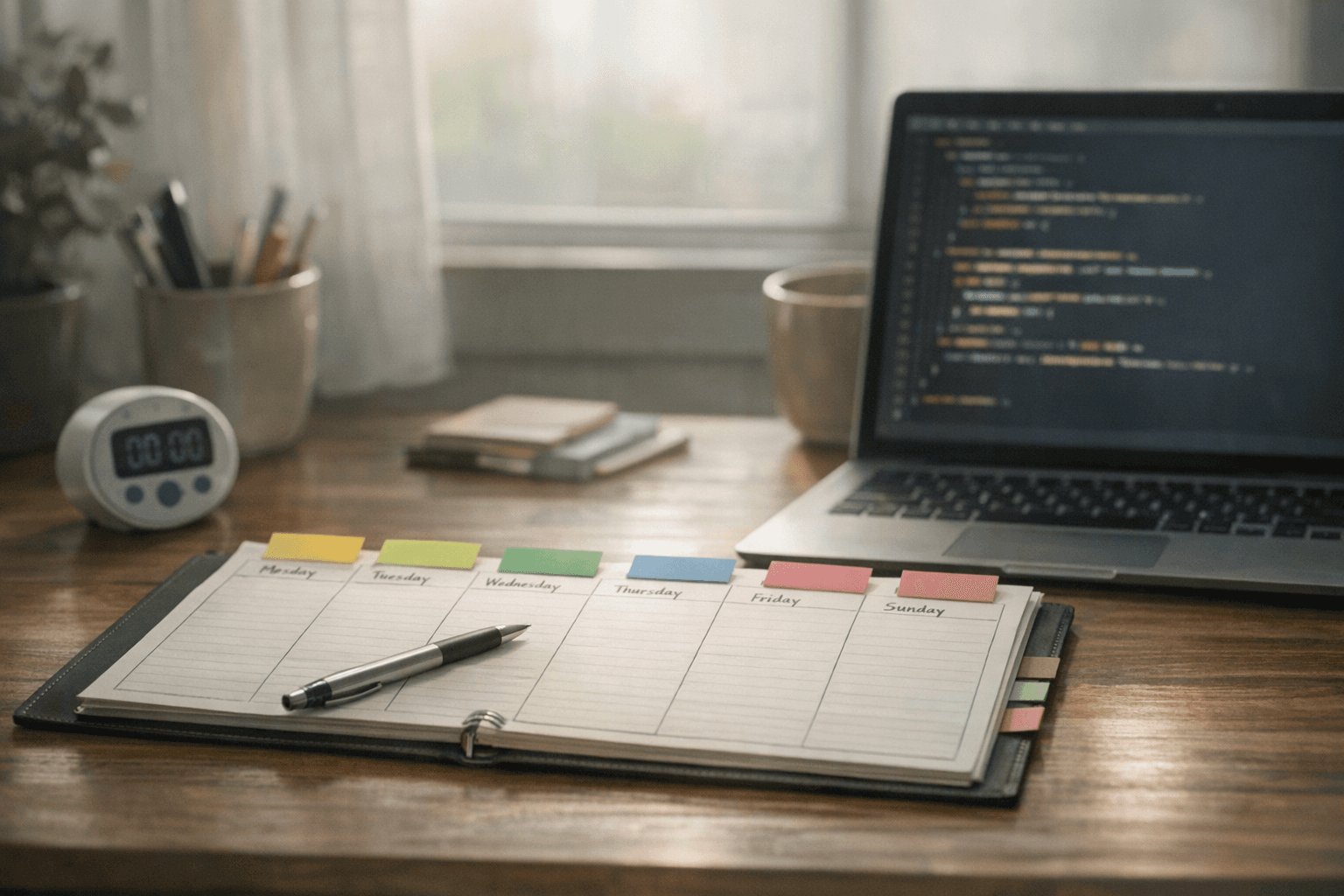
- Mon–Tue: two pattern slices (e.g., graphs + intervals).
- Wed: one system design prompt.
- Thu: one behavioral theme.
- Fri: one mock or timed set.
- Midweek 20-minute review: only items tagged “needs re-run.”
-
Prepare your environment (10 minutes)
- IDE + scratchpad ready. A timer. Camera-level post‑it with your first‑minute checklist.
- Open your bank and a few interview cheat sheets. Keep the browser quiet.
What timeline are you working with? Decide the total item count before adding a single prompt.
How IQB fits without becoming the star of the show
IQB is a piece of infrastructure, not the point. Use it if you want a structure that’s ready to go.
- IQB gives you a clean, pattern-oriented starting set so you don’t waste the first weekend formatting.
- You can tag and filter by company focus and difficulty, then attach your talk tracks and links in one place.
- It pairs naturally with Beyz practice: run drills in solo practice mode and keep your bank as the source of truth.
- During live sessions, keep notes minimal and lean on real-time interview support to prompt your framework—not to feed answers.
Your tools should lower friction. If you’re spending more time curating than practicing, you’re hiding from the work.
The weekly loop that compounds
A simple weekly rhythm beats a complicated plan you’ll abandon.
- Monday: Warm-up with a 10‑minute easy pattern; do two medium problems in your current slice. Narrate every step.
- Tuesday: Harder variant of the same slice. Add one constraint or edge case you usually miss.
- Wednesday: One system design prompt. Sketch with a 5‑minute structure, then drill one trade-off (e.g., cache invalidation, partitioning).
- Thursday: Behavioral. Choose a theme like “conflict resolution” and adapt the same story to two different questions.
- Friday: Mock or timed set: two coding problems back-to-back or one mock interview. Record and review your first five minutes.
Which part of your week consistently slips? Move it earlier, shrink it to 45 minutes, and protect it.
Consistency beats intensity. Leave gas in the tank so you show up tomorrow.
Spaced repetition without flashcard theater
You don’t need a complex app. Use “Next Review” dates and two rules:
- Missed an item? Schedule it in 2 days, then 7, then 21.
- Nailed an item twice? Push to 30+ days and replace with a variant.
When in doubt, tag “needs re-run” and drop it into your midweek 20‑minute block.
If you keep everything “urgent,” nothing is. Let strong items drift; double down on weak ones.
Using your bank in practice sessions
Keep it open while you practice, but don’t script. The bank sets the plan; you still solve from scratch.
- Pick today’s slice from your bank; start a timer; speak out loud.
- After each problem, write a 2‑line post‑mortem: what slowed you down, and what you’ll say next time.
- If you freeze, take a 30‑second reset and restate the problem and constraints. Then propose a simpler approach first.
Where do you hesitate—naming the right structure, or mapping constraints to patterns? Add those as bolded cues in your talk track.
The shortest post‑mortems produce the fastest improvements.
Using your bank in mocks and live interviews
Mocks test integration: pacing, framing, trade-offs, communication.
- Prep a one‑minute opening script per category from your bank’s talk tracks.
- For design, glance at your checklist before you start; then keep your eyes on the whiteboard.
- After a mock, tag two items “needs re-run” and put dates in “Next Review.”
In real interviews, keep prompts off-screen. Use your mental checklist, not a teleprompter. If you need help staying structured, lean on real-time interview support to nudge your sequence, not to answer for you.
Your bank prepares you; your behavior in the first five minutes wins the interview.
Common mistakes (and simple fixes)
- Overscoping: 200+ items with no review plan. Fix: cap at 60 and replace, don’t add.
- Collecting, not practicing: a beautiful sheet, no reps. Fix: schedule the week in the same file.
- No answer frameworks: good code, chaotic narration. Fix: add talk tracks and rehearse aloud.
- Ignoring system design and behavioral: coding-only prep. Fix: one design prompt and one theme weekly.
- Over-mocking: four mocks, no drills. Fix: one mock per week; drill the misses.
- Unclear feedback: vague notes like “got stuck.” Fix: name the exact decision that stalled you.
What would your past self have found useful to read in a note after a blown attempt? Write that.
A bank without clarity is just decoration.
Structured practice vs random grinding
Random sessions work for warm-ups or when you have only 10 minutes. But as a default, they hide gaps and inflate confidence.
- Structured practice targets one constraint at a time and repeats it across variants.
- Random practice makes you reactive; structured practice builds a playbook.
- Your bank enforces structure by narrowing the day’s choices.
Is your practice building reusable moves, or just collecting solved links? If you can’t name the pattern and the trade-off you just practiced, it didn’t stick.
Deliberate practice is the opposite of novelty seeking.
Fast add-ons that actually help
- Keep one page of interview questions and answers you revisit weekly. Your goal isn’t memorization—it’s smooth framing.
- Pair drills with the AI coding assistant for quick stubs and test scaffolds, then turn it off and solve.
- Use interview prep tools to gather everything in one place; reduce switching.
- When time is tight, run a 20‑minute “edges only” session: just enumerate edge cases and test plans for two problems.
Small, consistent boosts beat sporadic marathons.
Start Practicing Smarter
Stand up your bank today, then keep it boring and repeatable. If you want a head start, begin with a structured base from the interview question bank and run drills in Beyz’s solo practice mode. When you’re in a live loop, let real-time interview support nudge your structure, not your thinking.
References
- Spaced repetition (Wikipedia) — supports spacing effect and scheduling
- Indeed's STAR method guide — supports behavioral answer structuring
- GeeksforGeeks system design tutorial — supports core design topics and checklists
Frequently Asked Questions
How many questions should my interview question bank include?
Start lean: 40–60 total for a two-month window works for most engineers. Roughly split that into 20–25 coding patterns, 8–12 system design prompts, and 8–12 behavioral themes. If you go past 120, quality dips and review cadence breaks. You can expand later by replacing low-signal items, not by hoarding more. The goal is compression: the smallest set that exposes you repeatedly to the most common patterns you’ll actually be asked. If you have more time, add depth by variants of patterns rather than random new categories.
Should I build my own bank or use a prebuilt one like IQB?
Do both. Use a prebuilt base for coverage and consistency, then customize aggressively to your target companies and gaps. IQB provides structured starting sets and tagging so you don’t burn hours formatting. But your edge comes from notes, code templates, and personal failure patterns you add. Think of it like a syllabus: inherit the structure, then tailor the practice. If you only copy a template, you’ll miss the learning; if you only DIY, you’ll likely overscope and lose time.
How do I schedule reviews without turning this into a second job?
Use a simple weekly loop. Assign two topic slices, one design prompt, one behavioral theme, and one mock. Apply spaced repetition by revisiting last week’s weak items midweek. Keep sessions 45–75 minutes. Track in one page. If you skip a day, don’t stack debt—roll forward the highest-risk items. This keeps momentum and avoids the exact grind that causes people to quit. Your calendar should reflect a sustainable tempo, not an idealized bootcamp sprint.
What’s the fastest way to see improvement in coding rounds?
Narrate your thinking out loud while solving a small set of repeated patterns. Use a timed warm-up, restate the problem, propose a brute force, then optimize. Keep a short checklist near your camera or monitor edge. Record one mock a week and review the first 5 minutes only. The early structure—clarifying constraints, picking the right data structure, enumerating edge cases—moves the needle fastest. Don’t chase rare trick questions; audit your first five minutes instead.
Related Links
- https://beyz.ai/blog/top-5-ways-to-organize-your-interview-preparation
- https://beyz.ai/blog/beyz-ai-vs-chatgpt-interview-practice
- https://beyz.ai/blog/best-real-time-ai-interview-assistants-2026
- https://beyz.ai/blog/master-tell-me-about-yourself-interview-answer-tips-strategies
- https://beyz.ai/blog/why-soft-skills-matter-in-interviews-and-how-to-showcase-them-