Interview Question Bank: The No‑Grind Guide
2026年8月1日著者:Beyz Editorial Team
TL;DR
An interview question bank is a tagged, living set of prompts and answers you actually use, not a trophy shelf. Keep it lean, index by patterns and failure modes, and drill with short, focused timeboxes. Rotate coding, design, and behavioral work so you don’t overfit. Use a curated set like the interview question bank for coverage, then layer your own notes. Practice beats collecting. Mocks validate your process, not your worth. If you want a push on pacing and phrasing, bring in real-time interview support during rehearsals, not every rep.
What a Question Bank Is (and Isn’t)
A question bank is a working set of prompts, examples, and your notes—organized so you can find the next drill fast. It’s not an archive of every problem you’ve ever seen or a random playlist.
The bank is your autopilot for days when energy is low. It tells you exactly which two problems to do next and why. Does your current setup do that?
Two signals tell you it’s healthy:
- You can pull a 30‑minute session without thinking.
- Your past misses surface automatically within a week.
Schedule beats volume. If you can’t run a 30‑minute block on a weekday, the bank is too heavy.
Why a Lean Bank Works
Most candidates overcollect and underdrill. Endless variety looks productive, but you won’t build reflexes without repetition on patterns and edge cases. Lean beats broad when the clock runs.
A lean bank:
- Reduces decision fatigue: fewer choices, better focus.
- Emphasizes pattern exposure over novelty.
- Makes success visible with tags and short notes.
What’s the one tag in your bank that always makes you hesitate? That’s your next week’s focus.
Drill patterns, not just questions.
Core Structure: Tags, Slices, and Notes
Keep three levels of organization:
- Patterns: arrays, strings, two‑pointers, hashing, trees/graphs (BFS/DFS), DP, greedy, sorting/searching, heap/queue, bit tricks.
- Slices: small, intentional subsets (e.g., “two‑pointers + strings, easy‑medium” or “BFS on graphs only”).
- Notes: what failed, what to try first next time, and a tiny checklist (e.g., “read + write pointers, bounds, duplicate handling”).
Short notes compound faster than perfect solutions.
A good slice feels like a mini‑workout: clear start, clear finish, one muscle group.
How to Pick or Build Your Bank
You can build your own from scratch, or start with a curated source and adapt it. A curated hub like the interview question bank helps with coverage and tags; your annotations make it yours.
Selection rules:
- Two questions per core pattern at easy level, four at medium, one at hard.
- One “edge‑cases only” prompt per pattern (no coding, just enumerate pitfalls).
- One design mini for each: caching, rate limiting, pub/sub, pagination, backpressure.
If you’re tempted to add more, ask: will this change my first move in a common pattern?
Small beats perfect. You can add advanced variants once basics fire quickly.
Daily Drill Script (30–60 Minutes)
Here’s a compact session you can sustain for weeks:
- Warm‑up (3 minutes): voice‑over a solved problem from notes. No code.
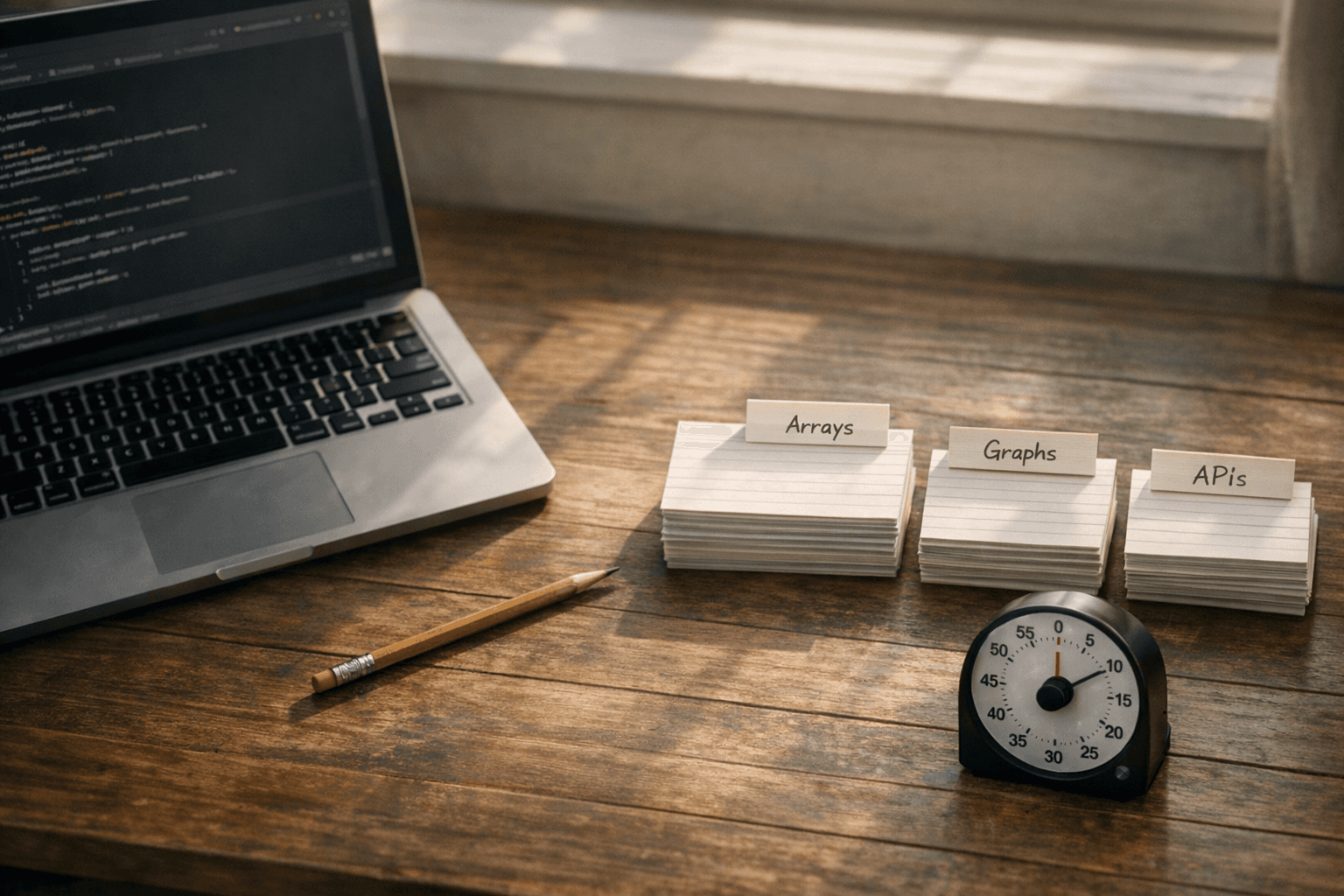
- Two drills (2 × 12 minutes): pick from today’s slice. State approach out loud, write code, unit‑test minimal cases, stop at the bell.
- One edge‑case sweep (5 minutes): list pitfalls without coding.
- Notes (3 minutes): one sentence each—first move, bug, next time.
Two days a week, replace the second drill with a 20‑minute design mini. On your design day, narrate trade‑offs in concise bullets.
Want help pacing or nudging your phrasing? Use solo practice mode to rehearse privately and tighten your timing.
Treat mocks as rehearsals, not exams.
Where IQB Fits
IQB (Interview Question Bank) is a practical way to keep structure without micromanaging spreadsheets. Use it as the backbone, not the plan.
- Pre‑tagged patterns and difficulty bands so you can select slices fast.
- Daily sets for lightweight spaced exposure; you can re‑roll a slice if you missed it yesterday.
- Room for short personal notes right next to each prompt; your reflections are the asset.
- Easy handoff to your practice workflow: jump from an IQB prompt into your editor or your interview cheat sheets for quick refreshers.
Tools don’t do the reps for you, but they can remove friction. If you can’t start a 30‑minute drill in under a minute, your system needs trimming.
Coding, Design, Behavioral: One Bank, Three Modes
Keep everything in one place with consistent tags. Change the mode, not the location.
- Coding: tag by pattern and failure mode (“off‑by‑one”, “null checks”, “dup handling”).
- System design: tag by topic (“caching”, “queueing”, “indexing”) and constraints (“read heavy”, “latency bound”, “throughput bound”).
- Behavioral: tag by competency (“ownership”, “collaboration”, “trade‑offs”), and link to your CAR/STAR bullets. Reference a reliable pattern like Indeed’s STAR method guide.
Rotating modes reduces overfitting and makes mocks feel routine, not exceptional.
Question Bank vs Practice vs Mock
You need all three, but they do different jobs. Don’t ask one to do another’s role.
| Approach | Primary Goal | When to Use | Common Mistake | Fix |
|---|---|---|---|---|
| Question Bank | Coverage + recall | Daily, short blocks | Hoarding problems | Keep a lean active set; retire solved items |
| Practice | Skill building | 30–60 min focused reps | Un-timed grinding | Timebox; narrate; jot the next-first-move |
| Mock | Process validation | Weekly or biweekly | Treating it like a test | Set one objective; review tape/notes after |
If your mocks feel inconsistent, it’s usually a practice or bank issue, not a “mock problem”.
Avoid These Bank Mistakes
- Collecting without curating. A thousand items won’t help if you can’t pick the next two in seconds.
- Solving once and moving on. Weak patterns need repeat exposure under time.
- Notes that tell a story, not a fix. Replace wall‑of‑text with “First move, Bug, Next time.”
- Using mocks to discover basics. Basics live in practice; mocks confirm you can perform on demand.
Which mistake shows up in your week? Pick one fix and run it for seven days.
Pattern‑First Coding: What “Good” Looks Like
For DS&A, “good” means you reach for the right tool quickly and avoid common pitfalls. Use a public reference to shore up gaps, like MIT OpenCourseWare algorithms for concepts or the concise GeeksforGeeks system design tutorial to revisit building blocks.
When you log a miss, categorize it:
- Search space: binary search boundaries, visited sets, pruning.
- Data structure choice: map vs set, heap vs sorting, linked list vs array.
- Implementation trap: indices, nulls, duplicates, early return, test data.
Revisit the same pattern within 72 hours. Short, repeated reps beat marathon sessions.
System Design Slices That Work
Design can feel ambiguous. Add structure with repeatable minis:
- Rate limiter for a high‑traffic endpoint: sketch token bucket vs leaky bucket, mention burst handling.
- Caching layer for read‑heavy service: choose cache keys, TTLs, invalidation path.
- Feed pagination at scale: pick cursor vs offset, point out backfill and cold‑start.
Narrate trade‑offs in bullets, not paragraphs. If helpful, keep a link to interview prep tools for quick diagrams and checklists you trust.
Design confidence comes from rehearsing the same trade‑offs with different numbers.
Behavioral: Stories That Don’t Meander
Write lean CAR or STAR notes:
- Context: one sentence, just enough to set the scene.
- Action: two or three choices you made, and why.
- Result: outcome and the lesson you’ll apply next time.
Use tags like “conflict”, “ownership”, “adaptation”. Refresh a story twice a week, and practice out loud. If pacing or phrasing is a hurdle, run it through real-time interview support once to tighten timing, then go back to solo reps.
Short, specific stories beat long tours of your resume.
Measuring Progress Without Getting Lost in Metrics
Keep one weekly checkpoint:
- Patterns cleared in under 12 minutes without surprises.
- Misses that repeated (same bug twice is a signal).
- Design minis where you stalled (note the trade‑off you skipped).
- Behavioral answers that ran over the timebox.
If you need content to check yourself against, browse the interview questions and answers hub for phrasing ideas, but always return to your notes with your voice.
Progress is fewer surprises under time, not a bigger spreadsheet.
Maintenance: Retire, Refresh, and Replace
A living bank needs pruning:
- Retire solved items after two clean runs; keep a “cold deck” for monthly checks.
- Refresh tags when your misses change (e.g., move from “null checks” to “boundary math”).
- Replace questions that are too niche with ones that hit your primary patterns.
If you want a maintenance template, this deeper dive on a maintenance playbook is a useful reference. For tagging discipline, see a tag‑driven workflow.
Your future self should thank you on a Wednesday night when energy is low.
Putting It Together: A Two‑Week Micro‑Plan
- Days 1–4: two coding drills from a single pattern slice + one edge‑case sweep; one design mini on Day 2; one behavioral story on Day 3.
- Day 5: light mock or timed practice set; review notes; retire one or two questions.
- Days 6–8: switch to the next pattern slice; repeat.
- Day 9: design mini with numbers; narrate bottlenecks.
- Day 10: mock focused on pacing and first moves; brief debrief.
- Day 11–12: plug repeats of the two stickiest misses.
- Day 13–14: rest or read; small warm‑ups only.
If you want to calibrate balance across the three pillars, this comparison of bank vs practice vs mock has a succinct rationale.
Start Practicing Smarter
Keep your bank light and your reps honest. Use the interview question bank for structured coverage, jot short notes that future you will read, and rehearse with solo practice mode when the schedule is tight. If pacing or follow‑ups wander, try one session with real-time interview support and bring the learnings back to your routine.
References
- GeeksforGeeks — System design tutorial — supports core design topics to slice and rehearse
- MIT OpenCourseWare — Introduction to Algorithms — supports pattern‑first DS&A refreshers and conceptual grounding
よくあるご質問
How many questions should my interview question bank have?
Enough to cover core patterns without turning into a museum. For most roles, 150–250 well-tagged questions across DS&A, system design, and behavioral is plenty. Balance by pattern coverage: arrays, strings, trees/graphs, DP, greedy, hashing, two‑pointers, sorting/searching. Add 20–30 role/company‑specific items. Retire solved questions and keep a small active set. The goal is coverage plus repetition, not hoarding.
Should I build my own bank or use a curated one like IQB?
If you already have a fragmented set, unify it. If you’re starting fresh, a curated set saves time. IQB gives structured tags and daily drill slices you can adapt. Either way, add your annotations: failure modes, edge cases you missed, timeboxes. The value lives in your notes and tags, not just the problems.
How do I mix coding, system design, and behavioral practice?
Think in small daily blocks. For example: 30 minutes DS&A (two targeted drills), 30 minutes design (one mini‑scenario), 15 minutes behavioral (one CAR or STAR story refinement). Rotate deeper design once or twice a week. Keep a shared tag vocabulary across your bank so you can pivot across domains without losing structure.
What’s the fastest way to recover if I’m behind schedule?
Cut scope, not structure. Reduce your active tag set to five patterns and focus on recent misses. Use 20‑minute timeboxes, narrate out loud, and finish each session with a two‑minute note on what you’ll try first next time. If you need a nudge on pacing or follow‑ups, lean on real‑time interview support sparingly to stay on track.