Beyz AI vs CoderPad.io:Prep Copilot vs Interview IDE
January 8, 2026By Beyz Editorial Team

TL;DR
Beyz and CoderPad support different parts of the interview journey. Beyz is a real time interview assistant and interview coach for candidates, built for interview practice, AI interview prep, and live execution in a video interview. CoderPad is interview software used by hiring teams, often acting as the browser IDE where you’ll do live coding and be evaluated on process. The winning approach is to use Beyz as your interview helper to rehearse a repeatable “think → speak → solve” loop, then walk into a CoderPad-style interview room ready to code, test, debug, and explain clearly.
Introduction
Most candidates don’t fail technical interviews because they “can’t code.” They fail because the interview compresses everything: an unfamiliar browser IDE, a timer (sometimes), a watcher, a follow-up mid-sentence, and that subtle pressure to type something before your plan is ready.
If you’ve ever blanked on a simple edge case, forgot the complexity after writing the correct solution, or got lost halfway through explaining why you chose BFS over DP—congrats, you’ve experienced the difference between knowledge and execution.
Beyz and CoderPad are closely connected to the same outcome—better technical interview performance—but they contribute in different ways.
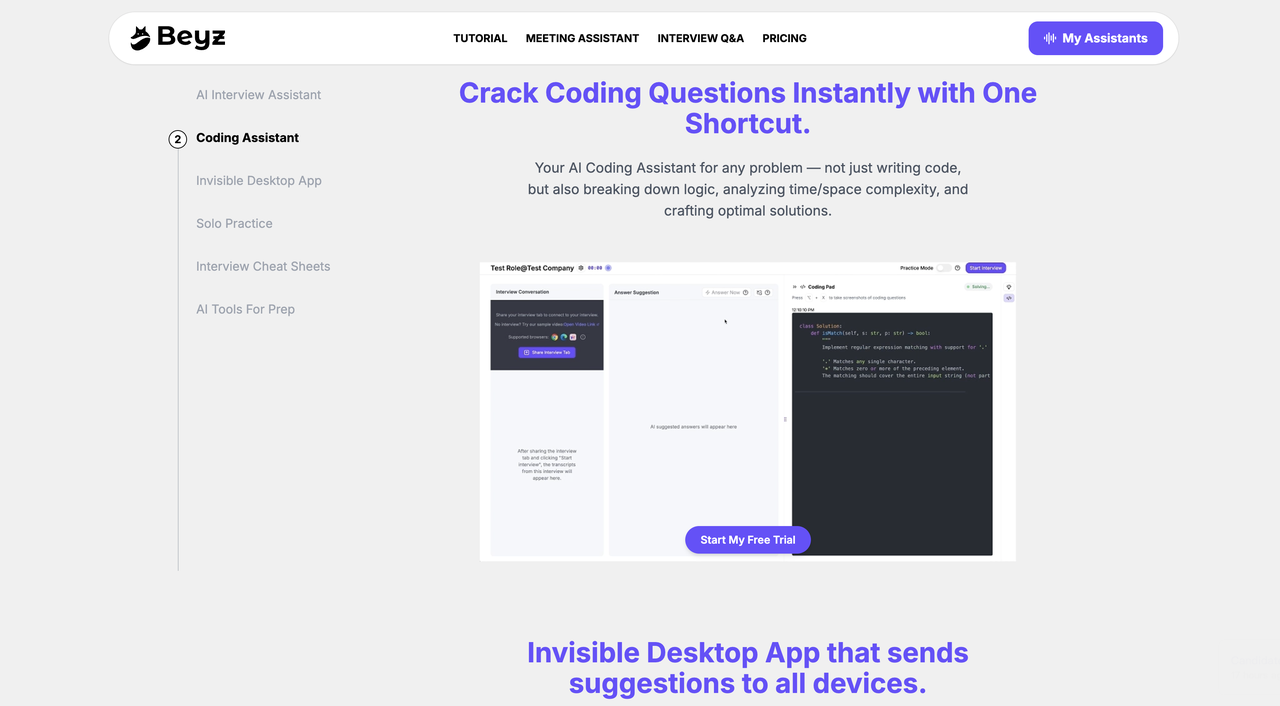
Beyz is a candidate-side performance copilot. It’s trying to keep your execution intact—structure, pacing, and clarity—especially when your brain wants to blank. Beyz explicitly positions an “Invisible Desktop App,” real-time interview suggestions, practice mode, cheat sheets, and a coding assistant for logic + time/space complexity.
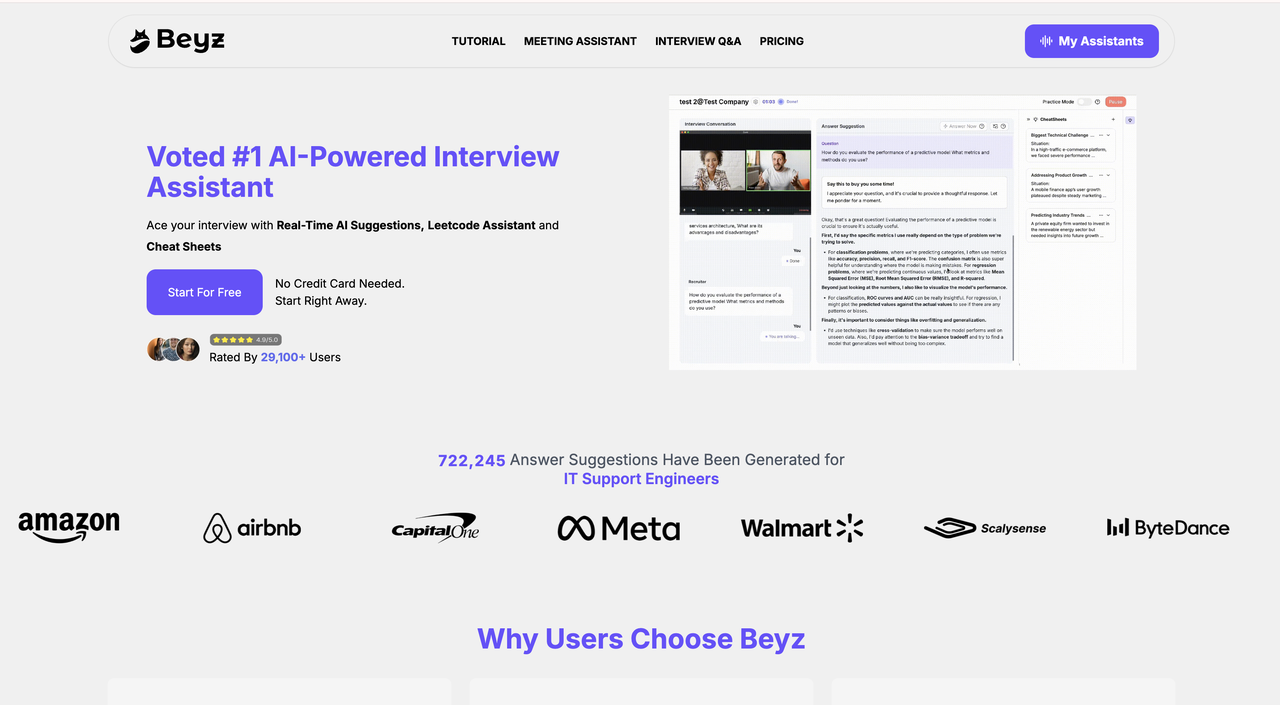
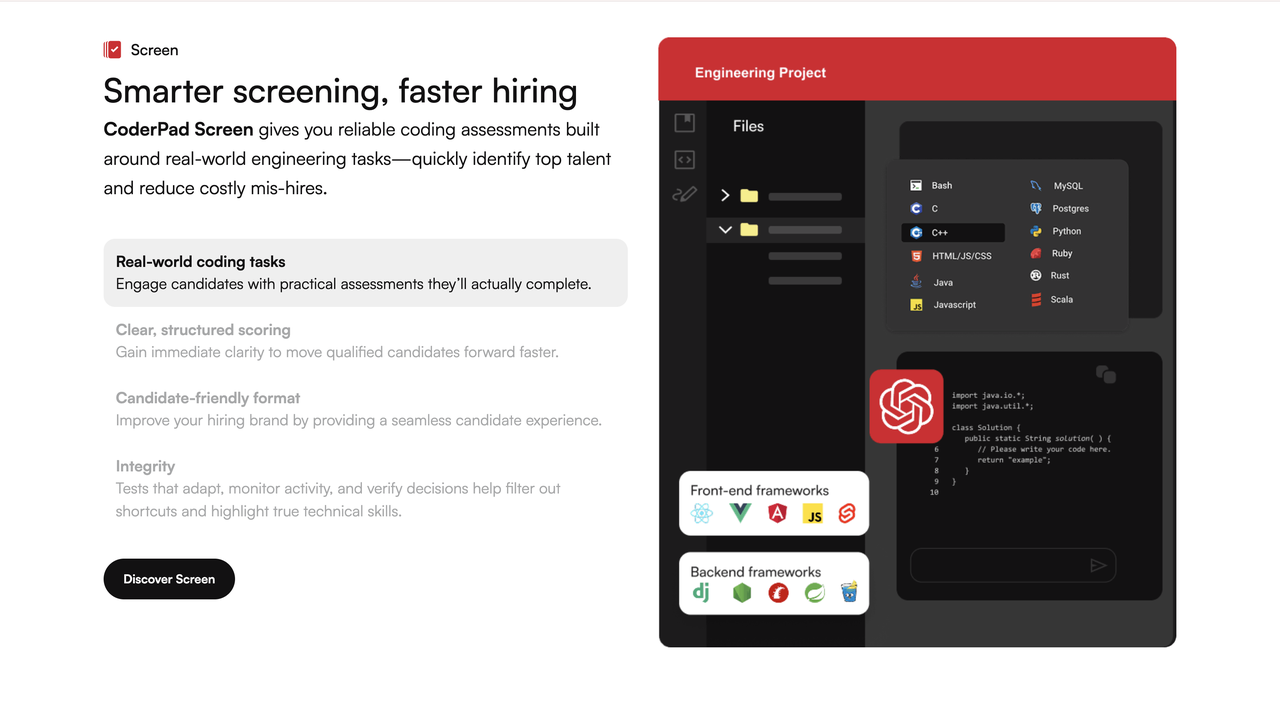
CoderPad is the interview room. It’s designed for hiring teams to run standardized technical interviews in a collaborative IDE (with features like multi-file workflows, run tests/output panes, interviewer notes, and playback review).
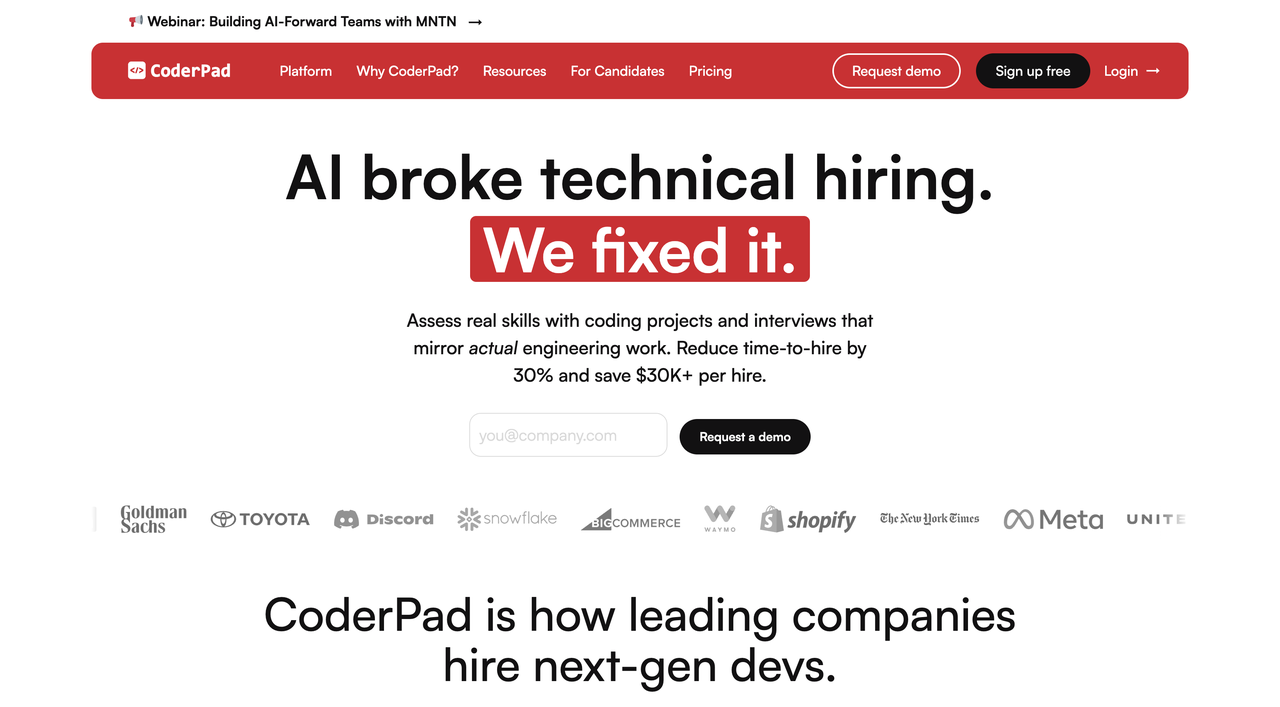
This guide maps what each one supports, and how to prepare for an interview so your performance holds up in real conditions—especially if your interview is tomorrow, your interview tmrw, or your interview coming up and you’re nervous about interview outcomes.
Product Overview
Beyz AI
Beyz interview helper is an AI interview assistant designed for execution. It combines interview practice with real-time support so you can perform in a video interview with less rambling, fewer blank-mind moments, and cleaner structure.
Core modules:
- Real-Time Coding Assistant: help narrating logic, edge cases, and time/space complexity.
- General Interview Assistant: live structure cues while you answer (behavioral + technical).
- Invisible Desktop App: listens to interviews, generates suggestions, and sends suggestions to all devices.
- IQB Interview Question Bank: collection of both technical and behavioral questions, categorized by company, industry and role.
- Solo Practice: repeatable Solo Practice to build “think → speak → solve” muscle memory.
- Interview helper for recall: quick-glance frameworks and story prompts when you’re nervous interview-wise.
CoderPad
CoderPad is interview software used by hiring teams. As a candidate, it usually matters because it can be the browser-based IDE where your technical interview happens.
From a candidate's perspective, what typically matters most:
- Interviews often feel closer to “pairing in an editor” than “whiteboard puzzles.”
- You may need to run code, debug quickly, and narrate decisions while you type.
- Depending on the company’s configuration, parts of your work process can be reviewed after (for example, a replay-like record of your session).
- Some interview formats include diagramming / whiteboard-like collaboration.
The key implication: you’re often evaluated on how you work, not only on the final answer.
Comparison Dimensions
Before the interview: preparation, repetition, and confidence building
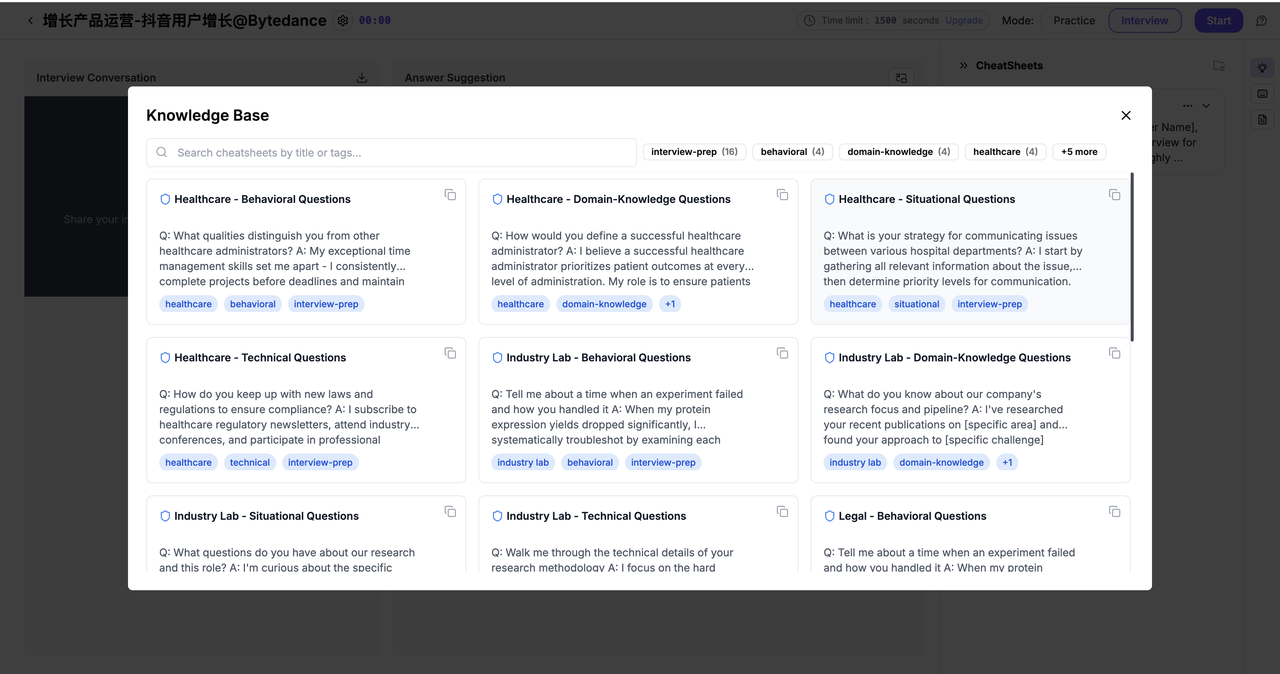
Beyz interview assistant is designed for candidates who want their prep to transfer into performance. In this stage, the goal is building a repeatable loop you can execute under pressure: clarify → plan → test cases → implement → validate → complexity → tradeoffs. With Solo Practice + Cheat Sheets + IQB, you can rehearse self-intro, behavioral/technical questions out loud and refine your explanation—so you don’t fall apart when the interviewer interrupts mid-solution.
What matters here is that many companies will later evaluate you in a browser-IDE environment, so “prep” should include at least one practice run in an IDE-like workflow mindset, like that on CoderPad.io. For a strong technical interview prep overview, the Tech Interview Handbook is a solid reference.
The first 3 minutes: problem framing and clarifying questions
Beyz interview assistant helps you start strong. A lot of candidates lose signal immediately by jumping into code too fast or failing to restate the problem clearly. A real-time interview assistant like Beyz can nudge you to slow down and front-load clarity: confirm inputs/outputs, ask about constraints, and outline an approach before typing. This is where “interview assistant” value is highest—because the cost of a messy start compounds for the next 30 minutes.
CoderPad.io, as the interview room, is where interviewers observe whether you can frame the problem like an engineer. They’re watching your questions, your assumptions, and whether you can translate ambiguity into a clean plan—inside a browser-based coding workflow.
Live coding: implementing under pressure while thinking out loud
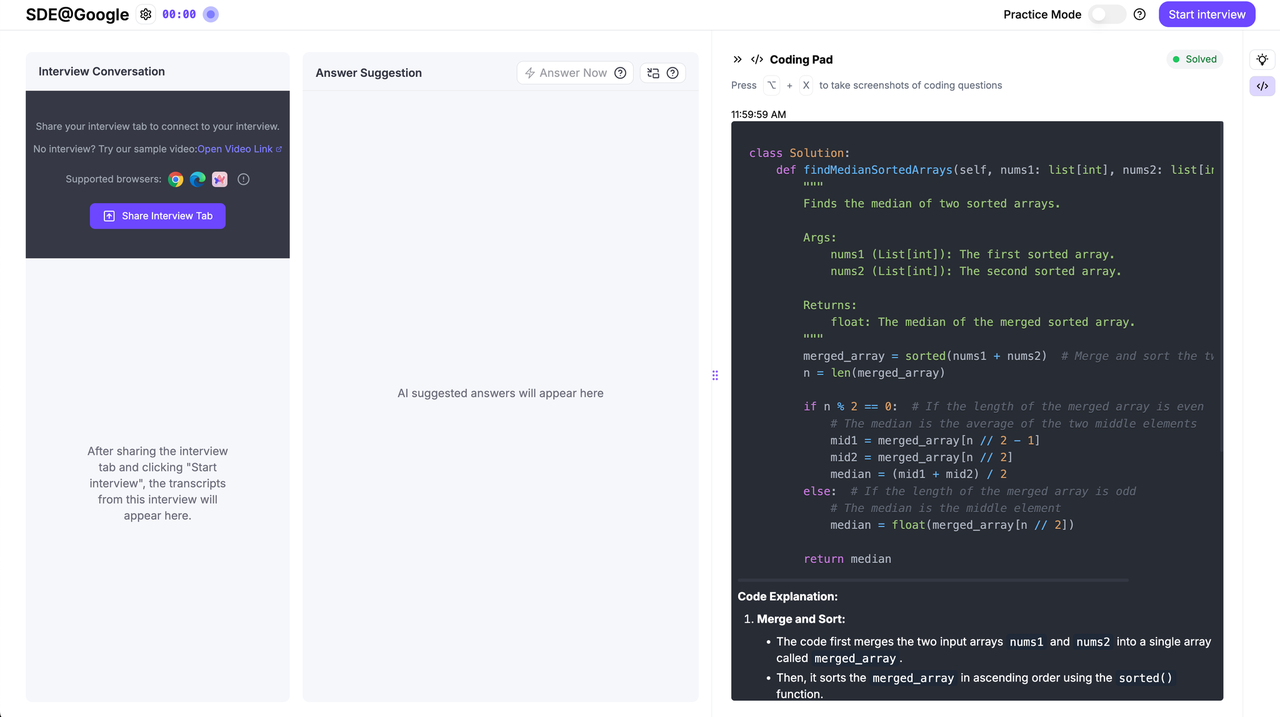
Beyz interview assistant supports the hardest part of technical interviews: executing. Beyz's Coding Assistant reinforces the narration layer: walk through an example, call out edge cases early, and keep your solution legible as you build it. Even when you get stuck, the goal is to stay structured rather than spiral.
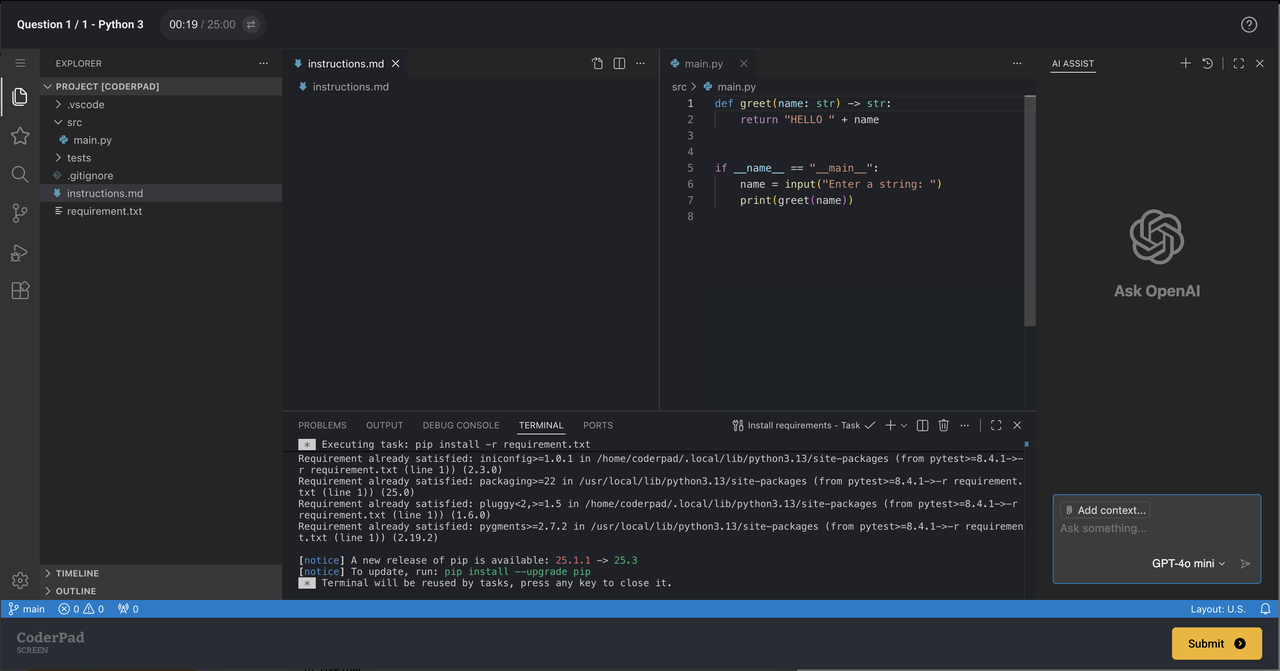
CoderPad.io turns the interview into something closer to “pairing in an editor,” which means how you debug, how you iterate, and how you collaborate matters. Candidates who do better in this setting tend to write in small steps, run quick checks, and narrate what they’re testing rather than silently hunting for the bug.
Debugging and validation: tests, edge cases, and recovery moments
Beyz interview assistant helps candidates avoid the classic failure mode: “works on one example, breaks on edge cases.” In practice, the fastest way to earn trust is to validate early: propose a couple of test cases, run through them mentally, and explicitly mention edge conditions. Beyz prompts can help you remember to do this even when you’re nervous—especially if you’re the kind of candidate who blanks during follow-ups.
CoderPad.io is where interviewers can see whether your debugging is systematic. They’re evaluating if you can isolate variables, reason from evidence, and explain why a fix is correct. In browser IDE interviews, recovery skill matters: getting stuck is normal; how you recover is the test.
Complexity and tradeoffs: the “finish strong” layer
Beyz interview assistant is useful at the end. Interviewers often expect a clean wrap-up: time complexity, space complexity, and at least one tradeoff or alternative approach. Beyz can remind you to land that conclusion clearly so you don’t lose points on presentation after doing the hard work.
CoderPad.io creates the conditions where interviewers can evaluate whether you understand performance implications. Candidates who state complexity confidently and connect it to constraints (“If n is 10^5, this passes; if streaming, I’d do X”) tend to score higher even with similar code quality.
System design discussions: structure, scope, and decision-making
Beyz interview assistant helps candidates keep system design answers structured: requirements → constraints → architecture → tradeoffs → recommendation. The most common failure in system design isn’t missing a component, it’s getting lost in details too early and never landing a coherent design decision. Beyz works well as an interview helper here by keeping your narrative clean and decision-oriented.
CoderPad.io interviews may include a collaborative diagramming surface depending on the employer setup, which helps interviewers observe how you communicate architecture. Regardless of the tool, interviewers want to see your reasoning: what you optimize for, what you sacrifice, and why the design fits the constraints.
Behavioral + follow-ups: staying concise and impact-driven
Beyz interview assistant helps candidates keep behavioral answers tight when the interviewer pushes deeper (“What did you do specifically?”, “What was the impact?”, “What would you do differently?”). Real-time structure cues are especially useful when candidates ramble or fail to land outcomes under pressure.
CoderPad.io's live follow-ups are about clarity, ownership, and decision-making. In technical interviews, follow-ups often behave like behavioral questions in disguise: your explanation of tradeoffs and debugging decisions communicates maturity.
Post-interview: what each product enables after the session
Beyz interview assistant supports learning loops. After an interview, candidates need to know what to improve: unclear explanation, missing edge cases, weak tradeoffs, poor pacing. Beyz's scripts can be saved to help candidates iterate—so the next interview isn’t a repeat of the last one.
CoderPad.io supports the interviewer’s evaluation workflow. Hiring teams often debrief based on how candidates worked in the environment: clarity, collaboration, correctness, debugging approach, and communication. That means your best strategy is to make your process readable—because “how you worked” can matter as much as “what you solved.”
Feature Comparison Snapshot
| Interview scenario | Candidate intent | How Beyz helps the candidate | How interviewers use CoderPad |
|---|---|---|---|
| Before the interview (preparation) | Build confidence, rehearse explanations, reduce interview anxiety | Solo Practice and AI interview prep help candidates rehearse answers, structure explanations, and build confidence | Not involved at this stage |
| Interview start (problem understanding) | Clarify requirements and restate the problem clearly | Real-time interview assistant nudges candidates to clarify assumptions and structure their opening | Interviewers observe how candidates frame and clarify the problem |
| Live coding (implementation & debugging) | Think out loud, write correct code, debug under pressure | Coding assistant reinforces step-by-step reasoning and edge case awareness | Interviewers evaluate coding style, debugging process, and collaboration in a browser IDE |
| Tradeoffs & complexity discussion | Explain time/space complexity and justify decisions | Real-time prompts remind candidates to cover complexity and tradeoffs | Interviewers assess depth of understanding and performance awareness |
| System design discussion | Stay structured and avoid getting lost in details | Interview helper cues guide requirements → constraints → design → tradeoffs | Diagramming and collaboration surfaces support design evaluation |
| Behavioral & follow-up questions | Deliver concise, impact-driven stories | STAR-based structure cues keep answers focused and complete | Interviewers evaluate communication, ownership, and clarity |
| Post-interview evaluation | Learn and improve for future interviews | Practice feedback and transcripts highlight gaps and strengths | Session artifacts support interviewer review and hiring decisions |
Feedback from users
- "Beyz is like having a coach whispering tips mid-interview."
- “What helped me most was using Beyz interview assistant where you can talk through product questions and get instant feedback. And you don’t need to coordinate with anyone. just open it up and start practicing.”
- “I am very happy to find such a good software. I want to use it for mock interviews.”
- “I stop rambling because the real-time prompts remind me to land the result.”
- “Cheat sheets help when I’m nervous and my brain blanks.”
- “The coding assistant nudges me to cover edge cases and complexity.”
Summary and Recommendations
What Beyz improves
Beyz helps you prepare for an interview the way high performers do it: repeatable interview practice, structured answers, and real-time guardrails so you don’t lose signal under pressure, especially in a video interview.
What CoderPad changes
CoderPad changes the setting: a browser IDE, live collaboration, and a process-oriented evaluation. That means you’re graded on how you clarify, test, debug, and communicate—not only on final code.
The prepping approach
- Build a repeatable loop with practice with Beyz: clarify → plan → test cases → implement → validate → complexity/tradeoffs.
- Do last-minute priming to reduce blank-minded moments and interview panic.
- Practice once in a browser-IDE mindset: run code early, narrate as you debug, keep steps small and readable.
- Optimize for signal on CoderPad.io: show your thinking, test early, and close clearly.
Ace Your Interview with Beyz!
Prepare with Beyz AI so your execution is consistent, then show up CoderPad-ready by practicing the environment once. Start building your loop here: Solo Practice, Cheat Sheets + IQB, and the Coding Assistant!
Additional Resources:
- LeetCode – Top Interview Questions (Most common coding interview problems by topic) – https://leetcode.com/problemset/top-interview-questions/
- HackerRank – Interview Preparation Kit (Hands-on practice for technical interview questions) – https://www.hackerrank.com/interview/interview-preparation-kit
- Google Engineering – Technical Interviewing at Google (How Google evaluates technical interviews) – https://careers.google.com/how-we-hire/interview/
- System Design Primer (GitHub) – System Design Interview Fundamentals (Popular open-source guide for system design interviews) – https://github.com/donnemartin/system-design-primer
- GeeksforGeeks – Data Structures and Algorithms Interview Questions (Topic-based DSA interview prep) – https://www.geeksforgeeks.org/data-structures/
Frequently Asked Questions
I’m nervous about interview performance—what should I do first?
Start with structure and repetition: rehearse answers out loud, tighten to a clear opening and close, and practice explaining your reasoning under time pressure.
How does the Beyz coding assistant help during technical interviews?
The Beyz coding assistant helps candidates structure their thinking while solving problems. It reinforces clear steps such as clarifying requirements, walking through examples, handling edge cases, and explaining time and space complexity—so interviewers can follow your reasoning as you code.
Is the Beyz coding assistant meant to write code for me?
No. The coding assistant is designed to support how you explain and reason, not to replace problem-solving. It focuses on guiding your approach, reminding you to articulate assumptions, tradeoffs, and complexity—skills interviewers actively evaluate in technical interviews.
Does Beyz help with explaining time and space complexity?
Yes. Explaining complexity is one of the most commonly missed steps in coding interviews. Beyz provides reminders to cover time and space complexity clearly before you conclude, helping you avoid losing points on otherwise correct solutions.
Can I use the Beyz coding assistant for interview practice?
Absolutely. Beyz supports interview practice through Solo Practice, where you can rehearse coding problems, practice thinking out loud, and refine how you explain solutions before facing a live interviewer.